Showing posts with label disability. Show all posts

Thursday, May 01, 2008

Blog Against Disabilism Day: Chess

It's been two years since I did BADD, so I thought I'd update folks on what's new: CHESS. My spouse has learned how to play chess. It all started with Lewis Caroll. After reading Through the Looking Glass to the Little Anachronism, my spouse (hereafter abreviated M.S.) got interested.

The Hadley School for the Blind Correspondence Courses (beginner and strategy) are the first step. Not that I couldn't teach the basic moves, and I did to some extent, but I've never studied chess formally, taught anyone to play and had no ideas whatsoever about how to adapt the game. M.S. has always had a bit of nervousness about spatial/strategic games, but figured it was worth trying. Hadley School adaptive chess board
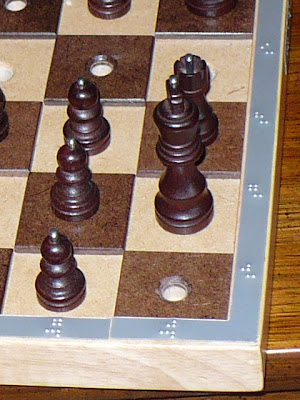
The Hadley course comes with an adaptive chessboard:
  • black and white squares are vertically offset (black is higher on this set, but not all), so the grid can be felt easily
  • there are braille markings for coordinates (especially useful since a lot of non-sighted chess is played by email)
  • the pieces have pegs on the bottom so they don't shift when you examine them tactilely
  • a metal peg at the top of the piece tells you that the color is black (see the closeup on the left; there are many variations on this, including sanded-down tops, bumps or other texture, and it's maker's choice which color gets the special indicator)
  • You can buy the set here, by the way.

Hadley School adaptive chess board closeup
Once M.S. got past the basic course, we started playing, and it quickly became part of our Saturday night routine. At first, I was serving very much as a tutor: making suggestions, warning of potential problems, allowing lots of take-backs. But while that was going on, M.S. was working through the strategy and principles course, reading through famous games, learning ways to understand what's going on that are well beyond my ken. I've never, as I said, studied chess (I studied Go and Shogi a bit, but it really doesn't help), and I haven't played regularly since high school. (Yeah, I was one of the geeks playing chess in the lunchroom and the library -- not a club, but regulars. We invented variations, like teleporting pieces to random places [the eight-sided D&D dice {I said I was a geek} came in handy] once a game instead of moving them.) As time has passed, I've been giving M.S. less and less advice and fewer take-backs. Two weeks ago we had our first game in which I basically gave no advice at all and M.S. never had to retract a move; in fact, the one truly dumb move of the game was my attempt to be aggressive and clever with a bishop, forgetting to note the plethora of pawns with which said bishop could be removed from its forward position; I still won, but it was a tight game most of the way.

In between our Saturday nights (and we don't make it every week, either), M.S. has been playing e-mail games with other members of the United States Braille Chess Association, and getting lots of great feedback and advice from some of their better players. Then there's the talking computer chess game, which M.S. uses to practice particular strategies and focus on error-free play. I don't think I'm going to win too many more before I start losing, and I actually expect to start losing big. M.S. is more careful than I am, more likely to take time to think things through, more devoted to practice and rapidly getting a really good feel for the board and the flow of the game.

It's been fun for all of us. Little Anachronism likes to play the talking computer chess on the lowest setting and M.S. follows along on the board to provide advice and practice position reading. We've added a new dimension to our relationship, and M.S. feels like the mental exercise is really worthwhile. Disabled or not: chess is a great game!

Now, go read the rest of the Blogging Against Disabilism Day posts and have a great May Day!

Sunday, September 02, 2007

Progressive Engagement With Disability

Penny Richards reminds me that -- as Tom Lehrer so memorably put it long before a disabiilty rights community existed -- the annual "make fun of the handicapped" event is going to happen again. For the last few years, there have been protests against Jerry Lewis and his Muscular Dystrophy Association telethon, and they are going to continue.

I'm something of a neophyte in the area of disability theory, though I have a personal interest as well as a historical one. Scholars who study disability distinguish between three models of disability: charity, medical and social. The Charity model is the oldest: the disabled are seen as being a burden, less than fully human, objects of pity, and their survival and lifestyle is determined by the sufferance and generosity of others. The Medical model is more recent: it defines the disabled as imperfect humans, deviants who should be fixed, to the extent that it is possible. "Find a cure" is the cry, and anything less than a cure is a pity. Perhaps the epitome of this view in recent culture is Clint Eastwood's Million Dollar Baby (spoiler alert) in which an athlete chooses death over a disabled life.

The Social model is most recent, and it is at the heart of the disability rights movement. The Social model sees disability in a much more nuanced fashion: disabilities do not affect the whole person (usually), but are part of a continuum (multi-dimensional) of abilities. The "challenge" of disability does not come from the disability itself, but from the ways in which society structures living spaces and habits of interaction with the assumption of ability. That normative assumption of ability is, of course, terribly flawed, because not everyone who's considered "able bodied" is equally so, and the vast majority of the population will experience at least temporary mobility, sensory or cognitive restrictions over the course of a lifetime -- thus the term "temporarily able-bodied." The Social model seeks access, adaptation and accomodation: technological and medical tools to solve problems; architectural, educational and employment changes to increase access for everyone; educating the broader public on the specific nature of disabilities, the essential and full humanity of the disabled, and the general utility of accomodations.

There are two other significant strains within the disability rights movements. The Social theory described above informs a pretty wide swath of disability civil rights activists, but not all of them. There are two other notable positions, each predicated on a negation of an older model: Overcoming/Passing and Separating.


Within the blindness community, activists centered on the National Federation for the Blind approach blindness as an inconvenience equivalent to left-handedness

The real problem of blindness is not the loss of eyesight. The real problem is the misunderstanding and lack of information that exist. If a blind person has proper training and opportunity, blindness can be reduced to a physical nuisance.
That sounds a lot like the Social model, but it's really an inversion of the Charity model: with technology (though the NFB has qualms about it, often pushing traditional low-tech solutions) and good education (emphasizing fully-blind mobility: NFB training centers insist that students with low vision wear blinders and guide dog users abandon them for the duration), the blind can overcome their blindness so they are not at all dependent on the sufferance of others. This extends to an actual philosophical objection to aggressive pursuit of Americans with Disability Act (ADA) "reasonable accomodation" changes, on the grounds that it compromises the independence of the blind to rely on sighted society adapting to their needs. I've heard the organization described as trapped in the "denial" and "anger" stages of grief.

There is also a long-standing tradition, most common among people with limited forms of disability (partial hearing loss, partial vision loss, some mobility issues, etc.) who are the children of "able-bodied" parents, of adapting to the disability by hiding it as much as possible, and "mainstreaming" as many activities as possible. You don't hear it as much any more, but there was a time when it was common for hearing parents of deaf children to refuse to learn sign language, forcing the children to focus on lip reading and vocalization. There was a time when visually impaired children with some sight, or with degenerative conditions, were not taught braille, on the grounds that they should use the sight they have, as much and as long as they have it. In both cases, the families are trying to help -- there's no real malice here, most of the time: we're talking about well-meaning people with flawed ideas -- by keeping their children from acquiring the markers of disability: "passing" instead of adapting. Again, this is an inversion of the Charity model, arguing that the disabled should aspire to emulate ability and eschew adaptation, as though one could "build up strength" and "avoid contagion" and therefore improve one's lot.

Then there is the "Deaf Community"/Pride model: arguing that ASL, etc., constitutes a distinct culture, smaller and different but no less legitimate than the Hearing Culture that surrounds it. This is an inversion of the Medical model: instead of seeing disability as a flawed version of a normative body, disability is a new norm to be celebrated rather than cured. I might include the Paralympics in this model as well, but I'm open to other arguments: my spouse seems to think that it's a reasonably healthy Social model adaptation. (Special Olympics definitely falls in the Charity category) Disability Pride activists strive for separateness: their heroes are the ones who focus their attentions primarily on the disability community itself, who articulate new artistic and cultural forms (or at least themes [or at least identities]) for and about disability. Deaf Pride activists have been known to refuse to authorize cochlear implant surgery which could restore partial hearing; it becomes controversial sometimes when Deaf parents of Deaf children decide to forego the surgery to keep their children within the community.


As a social historian with more than a touch of post-modernism in my system, I suppose that I'm kind of predisposed to see the Social model as "right": Ability and Disability are abstract categories, and the new medical, engineering and digital technologies are blurring the distinction even more than ever. The rising tide of aging Baby Boomers is going to make adaptation to sensory and mobility loss considerably more necessary, common, and economical.

The Medical model, all-or-nothing, cure-or-doom, is grossly outdated. "Lifestyle drugs" and "five-year survivor" and "living with the virus" are the new medical models anyway: everyone needs maintenance and we're still gonna die. The Charity model is just premodern: it's unrealistic and psychologically unsound for everyone involved. The converse positions -- passing/denial and separatism/pride -- are understandable reactions but inflexible and of limited utility to a very small portion of the relevant population.

As an historian, and as a progressive, the Social model and the disability civil rights movements are the key components of the future. If it requires raising loud objections to grossly outmoded public displays of self-indulgent do-gooding, so be it.
[Crossposted to Progressive Historians]